Naive Bayes Algorithm: Easy way understand like expert


Image for post

Bird’s eye view

In this article, you will be going to learn the Naive Bayes algorithm easily and after this, you can also talk to anyone about this like an expert.

Algorithm

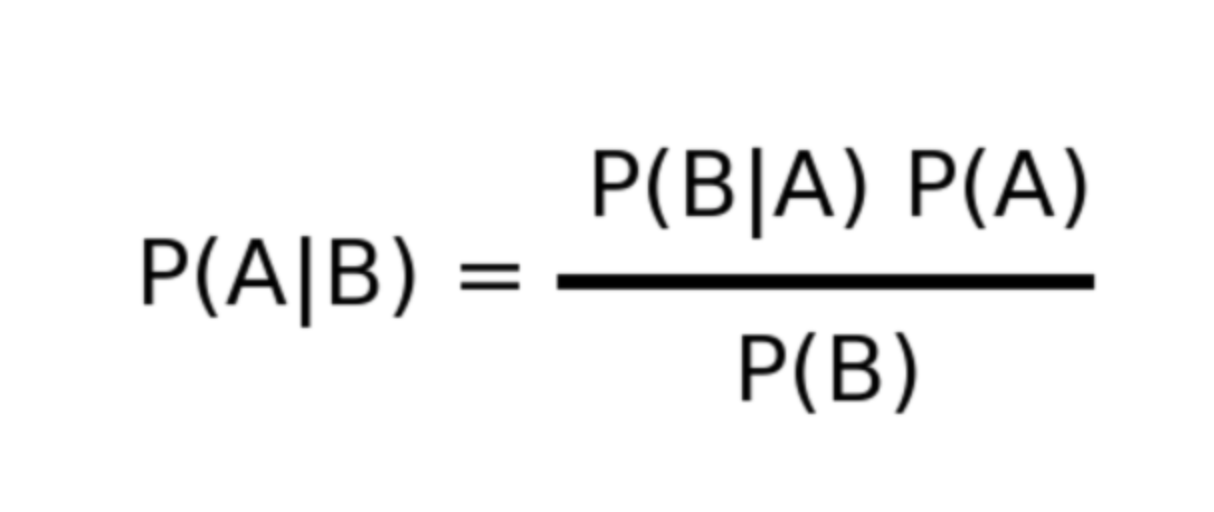
It is the algorithm that is working on the Bayes theorem which describes the method to find the probability of an action or event based on prior knowledge.

For example, a ball may be considered to be a ball if it is round, and about 5 inches in diameter. As we can see these features may describe the ball but these features are independent while contributing that ball is a ball. That’s why we call it a NAIVE.

Image for post

How it works

All you have to do is you just have to convert the data you have into the frequencies for all the classes and have to compute the probability of each case possible then you have to apply the Bayes theorem for prediction as simple as this. As you can see you just have to apply the formulae.

When you should use this

Suppose a situation comes, where you have to classify the data points into some classes and you know that there are too many points then easy way or you can say at sudden I will prefer you to do it by naive Bayes algorithm because it is too fast then others classification algorithm.

Comments

Popular posts from this blog

Random Forest and how it works

  Random Forest Random Forest is a Machine Learning Algorithm based on Decision Trees. Random forest works on the ensemble method which is very common these days. The ensemble method means that to make a decision collectively based on the decision trees. Actually, we make a prediction, not simply based on One Decision Tree, but by an unanimous Prediction, made by ‘ K’  Decision Trees. Why should we use There are four reasons why should we us e  the random forest algorithm. The one is that it can be used for both  classification and regression  businesses. Overfitting is one critical problem that may make the results worse, but for the Random Forest algorithm, if there are enough trees in the forest, the classifier  won’t overfit  the model. The third reason is the classifier of Random Forest can handle  missing values , and the last advantage is that the Random Forest classifier can be modeled for  categorical values. How does the Random...

DBSCAN Clustering Algorithm-with maths

  DBSCAN is a short-form of   D ensity- B ased   S patial   C lustering of   A pplications with   N oise. It is an unsupervised algorithm that will take the set of points and make them into some sets which have the same properties. It is based on the density-based clustering and it will mark the outliers also which do not lie in any of the cluster or set. There are some terms that we need to know before we proceed further for algorithm: Density Reachability A point “p” is said to be   density reachable from a point “q” if point “p” is within ε distance from point “q” and “q” has a sufficient number of points in its neighbors which are within distance ε. Density Connectivity A point “p” and “q” are said to be density connected if there exists a point “r” which has a sufficient number of points in its neighbors and both the points “p” and “q” is within the ε distance. This is a chaining process. So, if “q” is neighbor of “r”, “r” is neighbor of “s”, “s” ...

Neural Network theory and implementation for Regression

Introduction and background In this article, we are going to build the regression model from neural networks for predicting the price of a house based on the features. Here is the implementation and the theory behind it. The neural network is basically if you see is derived from the logistic regression, as we know that in the logistic regression: Formulae for Logistic Regression:  y = ax+b so for every node in each layer, we will apply it and after this output is from the activation function which will have the input from logistic regression and the output is output from the activation function. So now  w e will implement the neural  network  with 5 hidden layers. Implementation 1. Import the libraries which we will going to use 2. Import the dataset and check the types of the columns 3. Now build your training and test set from the dataset. 4. Now we have our data we will now make the model and I will describe to you how it will predict the price. Here we are making...